Omie & Irie and the Moon That Kept Changing Its Shape
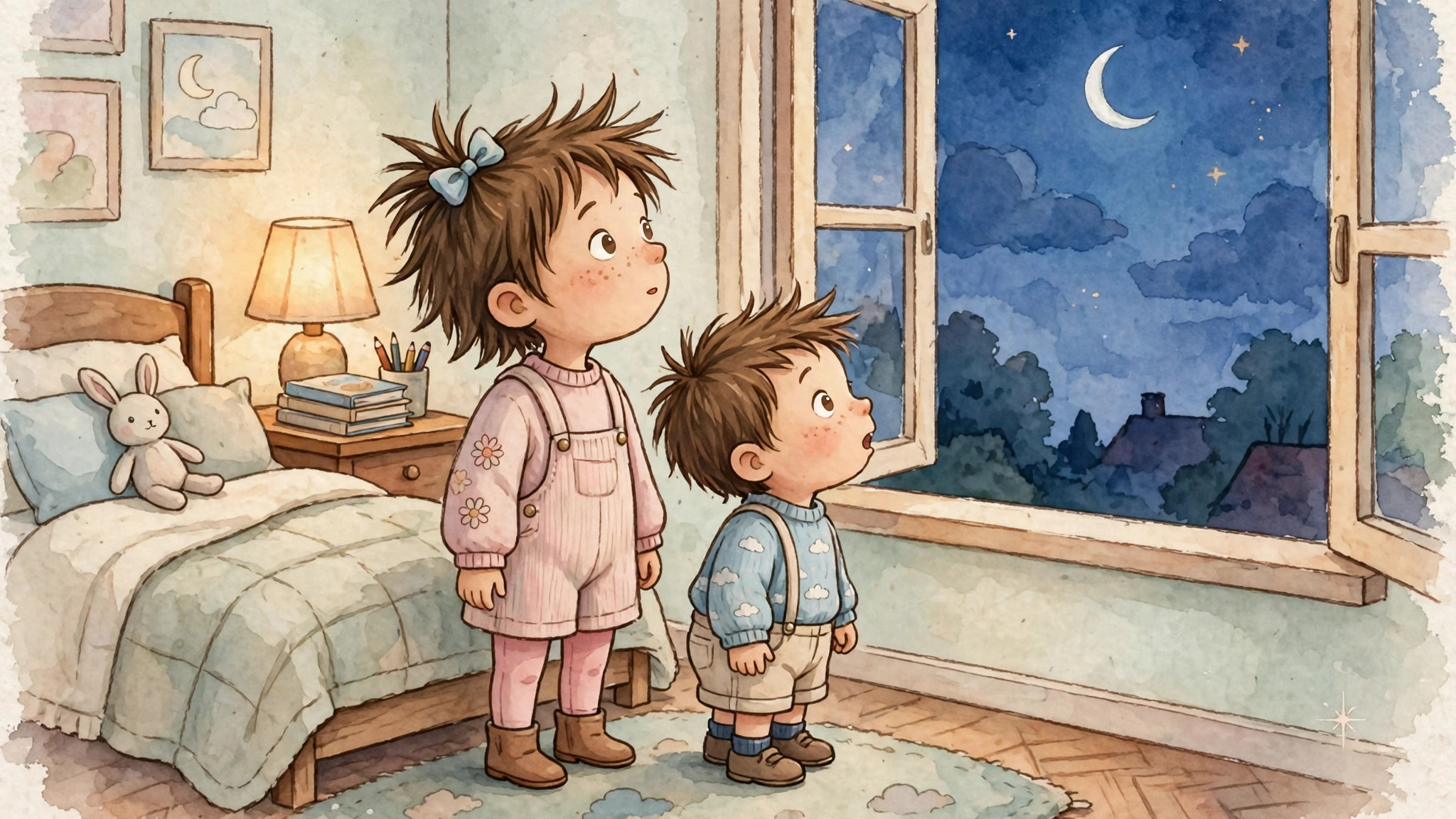
One evening, just after dinner, Irie and Omie were looking out the bedroom window at the darkening sky. The stars were just starting to pop out, one by one, like someone switching on tiny lights.
"Where is the moon?" asked Omie, pressing his nose to the glass. "Moon was BIG last week!"
Irie looked up. There it was — but it was not big and round anymore. Tonight the moon was only a thin silver smile, curving across the sky like the peel of a banana.
"You're right," said Irie. "Last week it was a big round pancake. Tonight it's a smile. Did somebody take a bite out of it?"
Omie gasped. "Who eat the moon?"
"I don't know," said Irie, grinning. "But we are going to find out. We are moon detectives now."
The Moon Journal
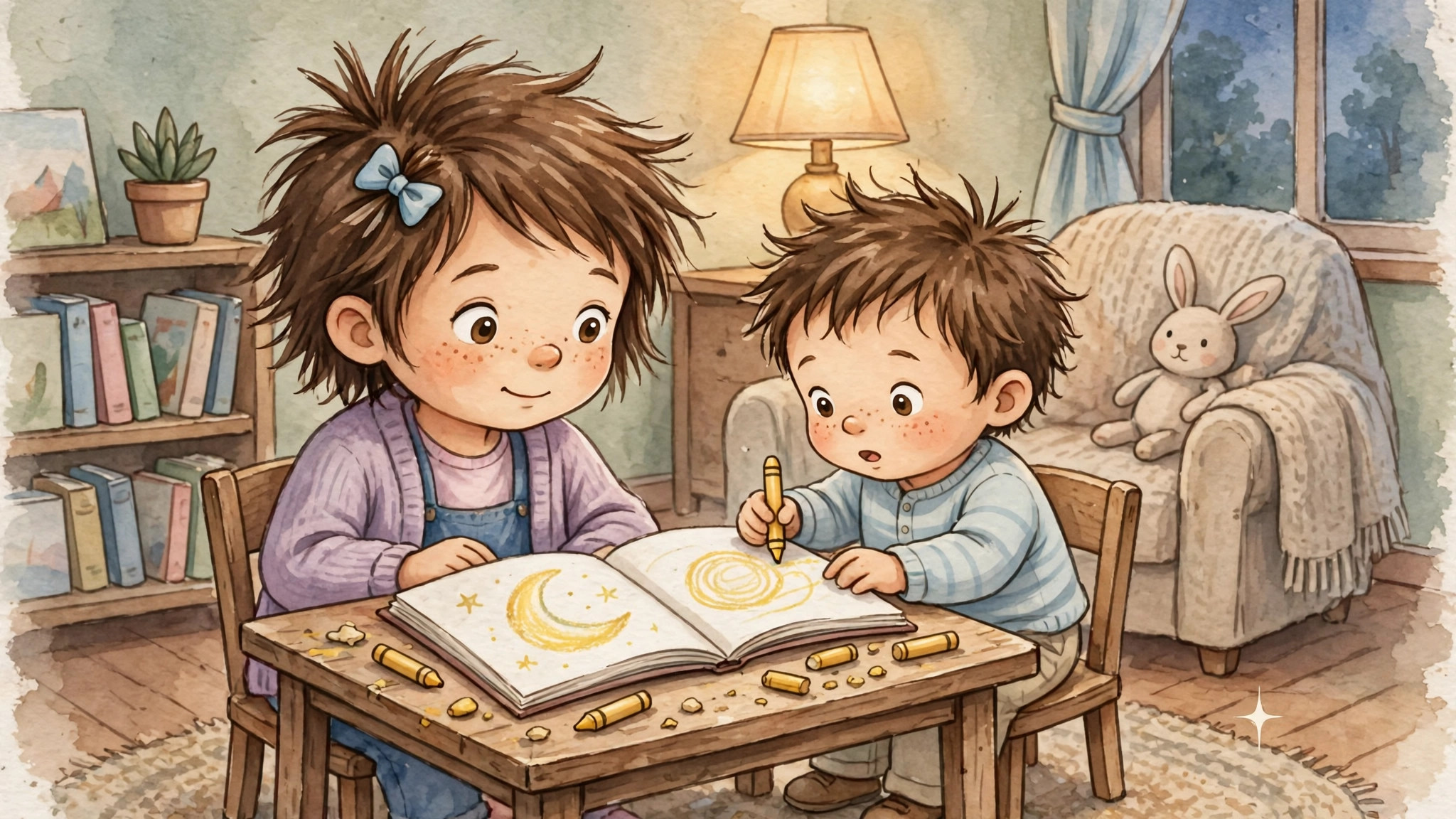
The next morning, Irie found an old notebook and drew a big circle on the first page. Inside it she drew a thin smile — the moon, exactly as they had seen it.
"Every night, we will draw the moon," she told Omie. "Same window, same time. Then we will see what it does."
Omie nodded very seriously, the way detectives do. He picked up a yellow crayon and drew a wobbly smile of his own.
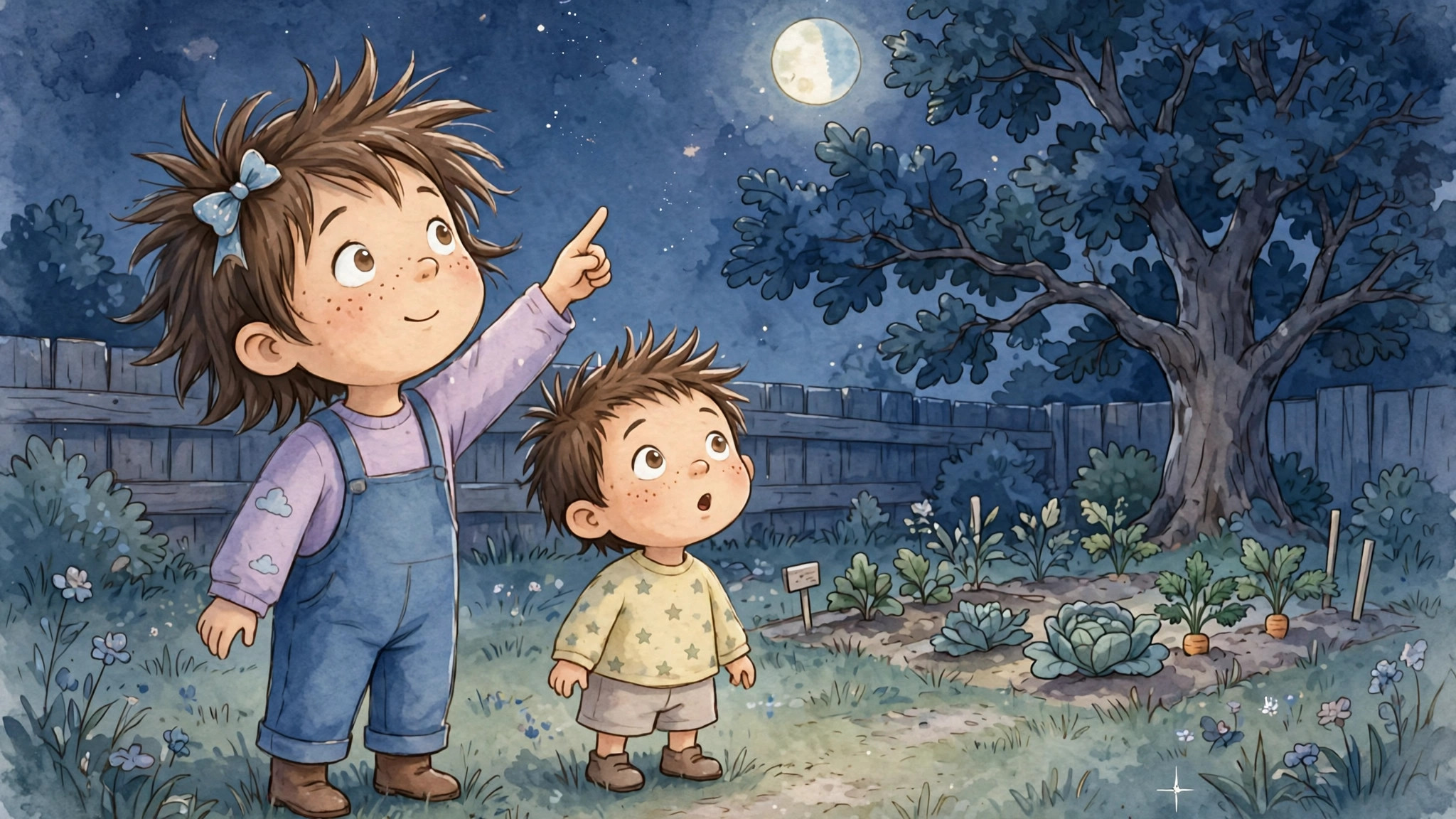
Night after night, they watched. The smile grew a little fatter. Then it became a half circle, like a cookie with one side bitten off. Then it puffed up more and more, until one night — there it was. Big. Round. Bright. A whole pancake moon, glowing over the backyard.
"Moon back!" shouted Omie, bouncing on his toes. "Moon all better!"
But Irie kept drawing. And slowly, night by night, the round moon began to shrink again. First a sliver was missing. Then more. Then it was a half circle again, then a thin smile, then — one night — nothing at all. The sky was dark where the moon used to be.
"Oh no," whispered Omie. "Moon all gone."
"Don't worry," said Irie, flipping through their notebook. "Look. It did this before. It shrinks, and then it grows back. It always comes back."
The Secret of the Shining Moon
"But WHY does it change?" asked Omie. "Moon is silly?"
Irie thought hard. She remembered something from science class — something about light.
"I think I know," she said. "The moon doesn't make its own light, like the sun does. It's like a big grey rock in the sky. The sun shines on it, and the part the sun hits glows bright — that's the part we can see. The part the sun doesn't hit stays dark, so we can't see it."
Omie frowned at the sky. "But the sun is gone at night."
"The sun is still shining," said Irie. "It's just shining on the other side of the world right now. And the moon is going around and around us, like it's dancing around the Earth. As it dances, the sun lights up a different part of it. So sometimes we see a smile, sometimes a half, sometimes the whole round pancake."
The Moon Lesson: The moon doesn't change shape at all — it is always a round ball. What changes is how much of its sunlit side we can see from Earth. As the moon travels around us, we see a little more of the lit side each night until it's full, and then a little less until it's dark again. The whole dance takes about a month, and then it starts all over again. That's why we call it a "month" — the word comes from "moon"!
The Flashlight Moon
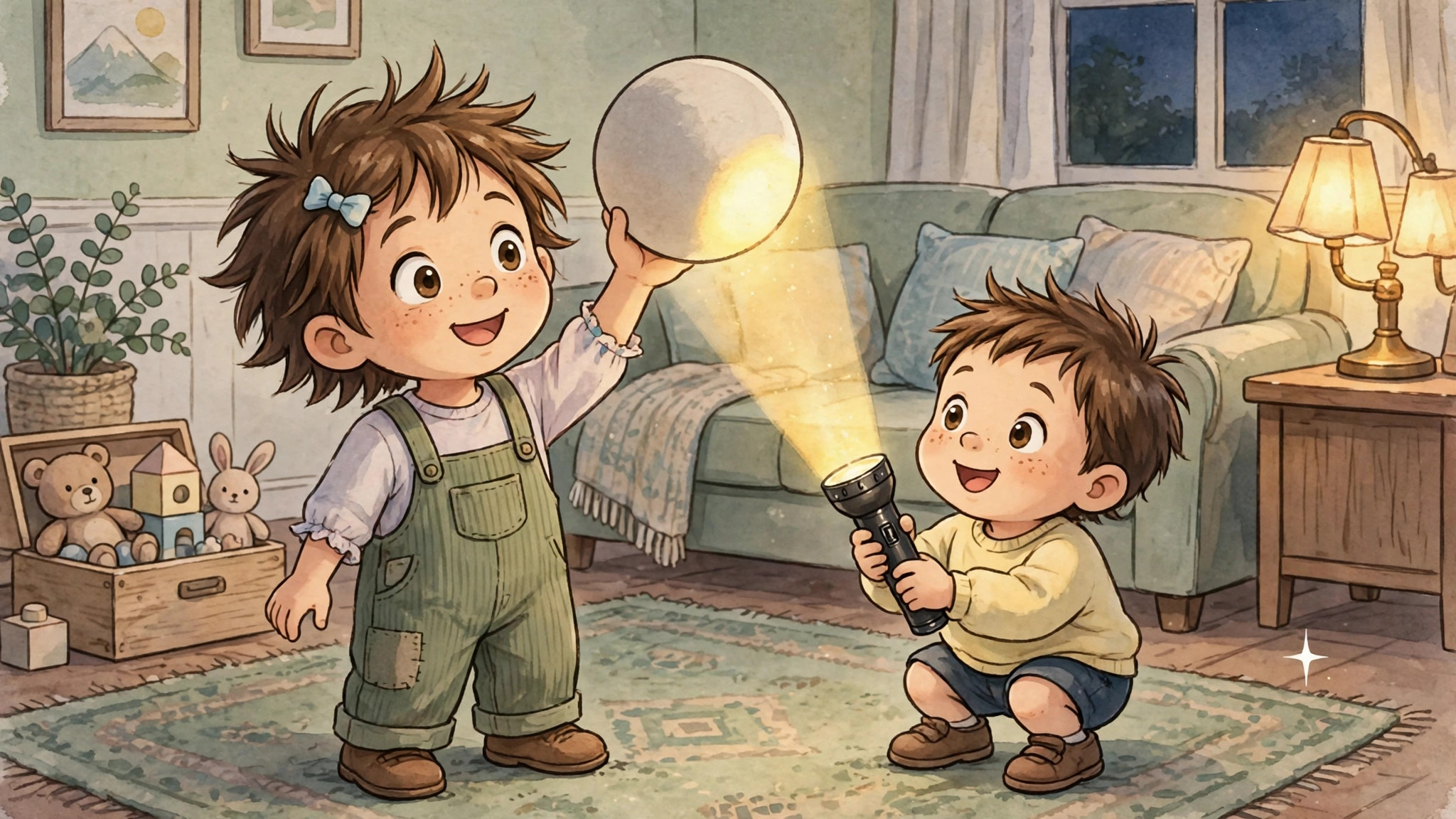
"Let's try it!" said Irie. She ran to get a flashlight and a ball from the toy box.
"You be the Earth," she told Omie, handing him the flashlight. "Hold it still. That's the sun."
Omie held the flashlight very still, the way a sun should.
Irie held the ball out in front of her. "And I am the moon, going around you." She walked slowly in a circle around Omie, holding the ball out to the side.
"Look!" she said. "When I'm on this side, the light hits the ball right in the face — full moon! And when I'm over here, the light only hits the edge — a smile moon! And when I'm behind you, you can't see the light at all — no moon!"
Omie turned the flashlight this way and that, watching the bright spot slide across the ball. He laughed. "Moon dancing!"
They did the dance three more times. Omie wanted to be the moon too, so Irie held the flashlight while he toddled in a slow, wobbly circle, holding the ball high above his head.
"Full moon!" he shouted. "Smile moon! No moon!" He knew them all now.
The Pancake Moon Returns
That night, they looked out the window together. The moon was growing fat again — a big golden pancake, rising over the rooftops, so bright it made soft shadows on the lawn.
"Moon back," said Omie happily. "Moon always comes back."
"Always," said Irie. "Every month, the same dance. Smile, half, pancake, half, smile, gone — and then it starts again."
They spread a blanket on the grass and lay down to watch it, the way moon detectives do. The stars twinkled around the big round moon, and somewhere an owl hooted, soft and low.
"Goodnight, moon," whispered Omie.
"Goodnight, moon," said Irie. "See you tomorrow. You'll be a tiny bit smaller, and we'll draw you in our book."
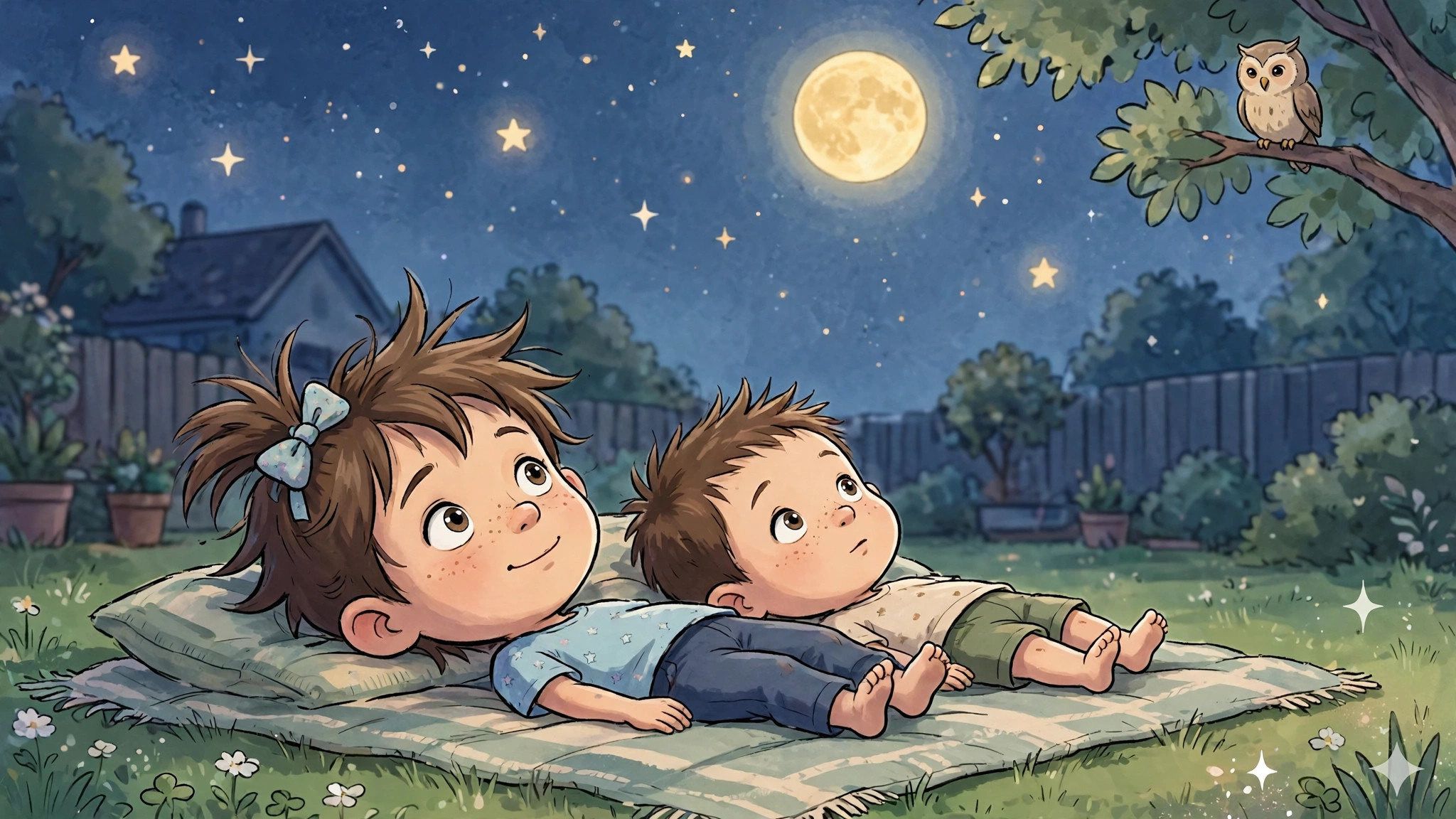
And that is how Omie and Irie learned the moon's secret: the moon never really changes its shape. It only shows us a little more, or a little less, of its sunny side as it dances around the Earth — a slow, patient dance that takes a whole month, every single month, forever.
The End. Tonight, look out your window: is the moon a smile, a half, a pancake — or is it hiding? Draw it in a notebook, and check again tomorrow night.